Course Overview
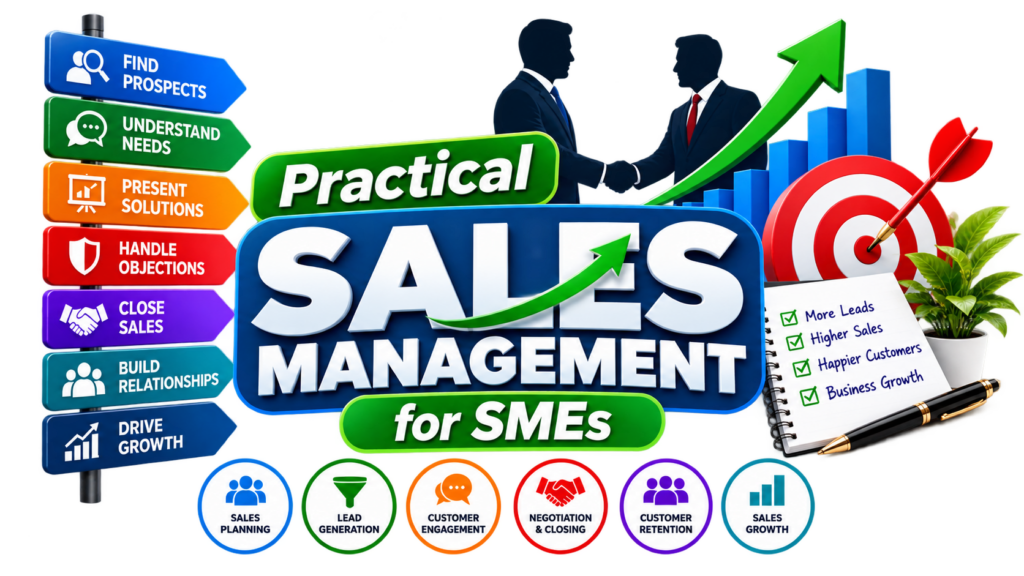
Practical Sales Management for SMEs is an intensive one-day physical training program designed to help entrepreneurs, SME owners, sales managers, sales executives and business development professionals build a more structured and effective approach to selling.
The program focuses on the complete sales process—from identifying the right customers and generating leads to understanding customer needs, presenting value, handling objections, negotiating, closing sales and developing long-term customer relationships.
Rather than focusing only on selling techniques, the training also introduces participants to sales planning, target setting, pipeline management and sales performance measurement, enabling businesses to manage sales as a systematic business function.
Program Schedule
Duration: 1 Day
Timing: 9:00 AM – 5:00 PM
Mode: Physical / Classroom Training
Level: Beginner to Intermediate
Target Audience: SME owners, entrepreneurs, sales managers, sales executives and business development professionals
Session 1 – Understanding Modern Sales Management
The program begins with the role of sales in business growth and the difference between simply selling products and systematically managing the sales function.
Participants will explore the modern customer buying process, B2B and B2C sales considerations, transactional versus relationship selling, customer expectations and the importance of developing a repeatable sales process.
The session will also introduce the basic sales cycle:
Prospecting → Qualification → Needs Assessment → Proposal → Negotiation → Closing → Follow-up & Retention
Session 2 – Sales Planning, Targets & Territory Management
Participants will learn how to convert overall business objectives into practical sales targets and activities.
Topics will include sales forecasting, setting realistic sales targets, breaking annual or monthly targets into actionable goals, customer and territory segmentation, allocating sales resources and prioritizing high-potential opportunities.
The session will emphasize the importance of managing both sales results and the activities that generate those results.
Session 3 – Prospecting & Lead Generation
A strong sales pipeline requires a continuous flow of qualified prospects. This session will cover practical approaches to finding potential customers through referrals, networking, digital channels, social media, databases, existing customers, business associations and direct outreach.
Participants will learn the difference between a lead, prospect and qualified opportunity, and how basic qualification can prevent sales teams from wasting time on low-potential prospects.
Session 4 – Consultative Selling & Customer Needs
This session focuses on moving from product-focused selling to customer-focused and consultative selling.
Participants will learn how to prepare for customer meetings, ask effective questions, identify stated and unstated customer needs, understand customer pain points, determine buying priorities and connect product or service features with meaningful customer benefits.
Practical discussion will cover how to develop a compelling value proposition rather than competing primarily on price.
Session 5 – Sales Presentation, Objection Handling & Negotiation
Participants will learn how to structure persuasive sales conversations and presentations around customer requirements.
Common objections relating to price, quality, competitors, timing, authority and perceived need will be discussed, together with techniques for understanding the real reason behind an objection and responding professionally.
The session will also introduce practical negotiation principles, including preparation, understanding interests, managing concessions and protecting profitability while pursuing the sale.
Session 6 – Closing the Sale
Closing should be a natural outcome of an effective sales process rather than a high-pressure activity.
Participants will learn how to identify buying signals, recognize when a prospect is ready to proceed, ask for commitment, clarify next steps and deal with last-minute hesitation.
The session will discuss different closing situations and the importance of documenting commitments and maintaining momentum after verbal agreement.
Session 7 – Customer Retention, Repeat Sales & Relationship Management
Sales management does not end when the first order is received. Existing customers can be an important source of repeat business, referrals, cross-selling and long-term profitability.
Participants will explore customer onboarding, after-sales follow-up, complaint handling, relationship management, customer satisfaction, repeat sales, cross-selling and upselling.
The session will emphasize developing customer lifetime value rather than focusing exclusively on individual transactions.
Session 8 – Sales Pipeline & Performance Management
The final session will focus on managing sales systematically.
Participants will learn how to structure a sales pipeline, define sales stages, maintain prospect information and follow-up activities, use basic CRM concepts and monitor key sales indicators.
Practical sales KPIs may include number of leads, qualified opportunities, meetings, proposals, conversion rate, average order value, sales cycle, target achievement and repeat business.
Participants will also discuss how managers can conduct regular pipeline reviews and identify where potential sales are being lost.
Practical Exercise – Building a Sales Action Plan
Participants will apply the day's learning to develop a simple sales action plan covering:
Target Customer → Lead Generation → Qualification → Customer Approach → Needs Assessment → Value Proposition → Proposal → Follow-up → Negotiation → Closing → Retention
Where appropriate, participants can develop the plan around their own business, product or service.
Who Should Attend?
This program is suitable for SME owners, entrepreneurs, startup founders, sales managers, sales executives, business development professionals, marketing personnel, customer relationship personnel and professionals responsible for generating business revenue.
It is particularly useful for businesses that currently depend on informal selling and want to develop a more structured and measurable sales process.
Training Methodology
The course will use interactive presentations, practical examples, sales scenarios, exercises, role discussions and question-and-answer sessions.
The emphasis will be on techniques that participants can practically apply in their businesses rather than sales theory alone.
Learning Outcomes
By the end of the program, participants should be able to understand and structure the complete sales process; establish practical sales targets; identify and qualify prospects; conduct more effective customer conversations; identify customer needs and communicate value; handle common sales objections; negotiate more effectively; recognize closing opportunities; develop stronger customer relationships; manage a sales pipeline; and monitor key sales performance indicators.
Expected Practical Outcome
Participants should leave the program with a clearer and more systematic approach to generating leads, converting opportunities into customers and managing sales performance. SME owners and managers should also be better equipped to monitor and guide the activities of their sales teams.