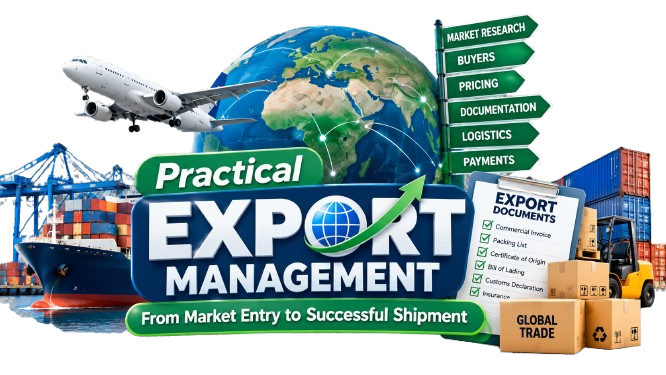
Course Overview
Export Management is an intensive 3-day physical training program designed to provide participants with practical knowledge of the complete export process—from assessing export readiness and identifying international markets to export documentation, pricing, logistics, payments, compliance, and execution of export orders.
The program is particularly suitable for SMEs, exporters, manufacturers, entrepreneurs, export managers and professionals who want to start exporting or improve their existing export operations.
Through practical examples, exercises and discussions, participants will learn how to develop an export strategy, identify suitable markets and buyers, calculate export prices, understand Incoterms, prepare essential documentation, manage international payments, coordinate logistics, and minimize common export risks.
Program Schedule
Duration: 3 Days
Timing: 9:00 AM – 5:00 PM each day
Mode: Physical / Classroom Training
Level: Beginner to Intermediate
Total Training Duration: Approximately 24 Hours
Day 1 – Export Readiness, Market Selection & Export Strategy
Session 1: Understanding the Export Business
Introduction to international trade and exporting; benefits and challenges of entering international markets; different export business models; direct and indirect exporting; understanding the export ecosystem; and the roles of exporters, importers, freight forwarders, customs agents, banks and regulatory organizations.
Session 2: Export Readiness Assessment
Assessing whether a business and its products are ready for export; production capacity; product quality and consistency; packaging requirements; financial capacity; human resources; compliance considerations; and developing an export-readiness checklist.
Session 3: International Market Research & Selection
Identifying potential export markets; understanding international demand; market size and trends; competition analysis; tariff and non-tariff considerations; selecting priority markets; and using online trade information and market intelligence resources.
Session 4: Finding International Buyers
Methods for identifying prospective overseas buyers, distributors and agents; B2B platforms; trade fairs and exhibitions; chambers and trade organizations; business directories; digital prospecting; preparing an exporter/company profile; approaching international buyers; and managing initial buyer communication.
Day 2 – Export Pricing, Incoterms, Documentation & Payments
Session 5: Export Costing & Pricing
Understanding the components of export cost; EXW, FOB, CFR and CIF pricing concepts; freight and insurance considerations; packaging and handling costs; commissions; bank charges; margins; exchange-rate considerations; and preparing a practical export price quotation.
Session 6: Incoterms in Export Transactions
Understanding the purpose of Incoterms® and allocation of costs, responsibilities and risks between seller and buyer. Practical discussion of commonly used terms including EXW, FCA, FOB, CFR, CIF, CPT, CIP, DAP and DDP, and selecting an appropriate term for an export transaction.
Session 7: Export Documentation
Understanding and preparing major export documents, including:
Commercial Invoice, Proforma Invoice, Packing List, Certificate of Origin, Bill of Lading/Air Waybill, insurance documents and other shipment-related documents. The session will also discuss product- and destination-specific certificates and documentation requirements.
Session 8: International Payment Methods
Understanding advance payment, open account, documentary collection and Letters of Credit; payment risks for exporters and importers; basic LC terminology and document compliance; banking considerations; foreign currency issues; and selecting appropriate payment terms for different buyers and transactions.
Day 3 – Logistics, Compliance, Risk Management & Export Execution
Session 9: Export Logistics & Shipment Management
Understanding sea, air and land freight; containerized shipments; LCL and FCL concepts; freight quotations; working with freight forwarders and customs agents; shipping schedules; cargo insurance; shipment planning; and controlling logistics costs.
Session 10: Customs, Regulatory & Product Compliance
Understanding customs and export procedures; HS codes and product classification; duties and tariffs; rules of origin; restricted and controlled products; destination-market requirements; labeling and packaging considerations; standards and certifications; and the importance of verifying product-specific regulatory requirements before shipment.
Session 11: Export Risk Management
Identifying commercial, payment, currency, logistics, documentation, political and buyer-related risks; buyer due diligence; avoiding documentation discrepancies; managing shipment delays and claims; insurance considerations; and developing basic risk-control procedures for export transactions.
Session 12: Managing an Export Order – Practical Exercise
Participants will work through a practical export transaction covering:
Buyer inquiry → quotation → negotiation → order confirmation → payment terms → production/packing → documentation → customs/logistics → shipment → payment realization → post-shipment follow-up.
The exercise will help participants understand how the different elements covered during the three days connect in an actual export transaction.
Who Should Attend?
This program is suitable for:
Existing and potential exporters; SME owners and entrepreneurs; manufacturers and traders; export and business development managers; sales and marketing professionals; supply-chain and logistics personnel; startup founders; and professionals responsible for international business operations.
Participants planning to enter export markets for the first time can use the program to understand the complete export process, while existing exporters can use it to strengthen their operational and management practices.
Training Methodology
The program will use a combination of interactive presentations, practical examples, case discussions, document demonstrations, exercises and question-and-answer sessions.
Where possible, participants will be encouraged to relate exercises to their own products and target export markets so that the learning can be applied directly to their businesses.
Learning Outcomes
By the end of the three-day program, participants should be able to assess their business's export readiness; identify and evaluate potential export markets; understand approaches for finding international buyers; prepare export quotations and calculate export prices; select appropriate Incoterms and payment methods; understand major export documents; coordinate logistics and shipment activities; recognize important customs and compliance requirements; identify common export risks; and understand the complete workflow for managing an export order.
Expected Practical Outcome
Participants should leave the program with a clearer export action plan and an operational understanding of how to take a product from initial international-market assessment through buyer engagement, pricing, documentation, shipment and payment.